Cost of App Development in Dubai: 2026 CEO Playbook | The Bridge Technology
Discover real Dubai app costs, ROI drivers, and savings tactics. Learn when to choose PWA or native, and budget with confidence. Book a free consult today.
A clear, data informed guide for CEOs in the UAE to budget app development, reduce risk, and maximize ROI. Learn price bands, timelines, and why PWA first wins.
Category: Mobile Apps
Key Takeaways
- Dubai app budgets cluster in three bands: AED 60,000 to 180,000 for focused MVP, AED 200,000 to 500,000 for growth stage products, AED 500,000 to 1.5 million for complex enterprise or multi product lines.
- PWA first saves 30 to 50 percent against separate native teams, while still shipping an installable app experience with store presence and offline support.
- ROI improves when you ship a revenue critical slice in 8 to 12 weeks, then scale features based on validated usage and CAC to LTV ratios.
- Hidden costs to plan for: cloud, analytics, SMS OTP, maps APIs, payment gateways, security testing, bilingual Arabic and English, and data compliance under UAE PDPL.
- The Bridge Technology delivers Progressive Web Apps that feel native and are installable from Google Play and the App Store, paired with data driven growth and Support.
Good morning, founders and CEOs. If you are planning a new product launch, a digital transformation program, or a strategic spinout, clarity on the cost of app development in Dubai is essential. This guide gives you price signals, ROI frameworks, and a modern path to lower total cost of ownership without sacrificing performance or brand.
What drives app cost in Dubai
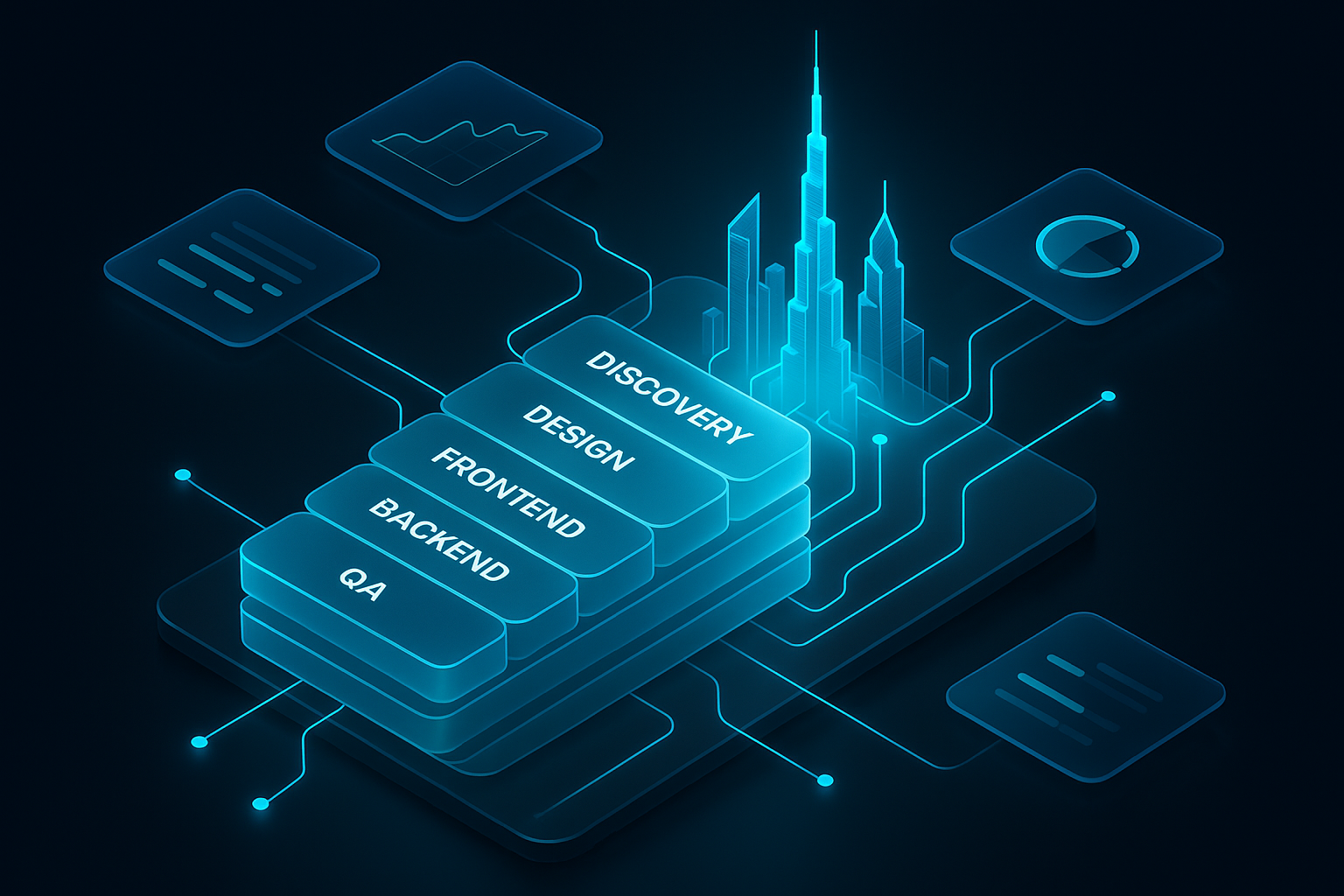
Cost is the product of scope, team model, and risk. In Dubai and the wider UAE, four variables dominate budgets.
- Platform choice: PWA, native iOS, native Android, or a hybrid stack. Separate native teams duplicate effort. A PWA first approach consolidates most of the codebase.
- Feature depth: authentication, payments, chat, location, push notifications, media handling, offline sync, role based access, and admin analytics. Each capability adds design, implementation, and testing surface area.
- Integrations: ERP, CRM, POS, loyalty, delivery partners, payment gateways such as Amazon Payment Services, Telr, Network International, Tap, and mapping services. Integration stability and SLAs affect both effort and risk buffers.
- Compliance and localization: bilingual Arabic and English UI, right to left layouts, PDPL privacy controls, TDRA messaging rules, and enterprise security expectations.
Typical price bands you can use for planning
Every product is unique, but consistent market data in the UAE gives reliable bands for initial planning. These estimates include design, engineering, QA, and project management.
- MVP PWA, one core journey, installable experience, analytics, and a simple admin: AED 60,000 to 180,000.
- Growth stage product, richer features, deeper integrations, and data dashboards: AED 200,000 to 500,000.
- Enterprise grade or multi product suite, heavy integrations, security audits, and scale requirements: AED 500,000 to 1.5 million.
Plan ongoing operations at 15 to 25 percent of build cost per year. This covers cloud, monitoring, minor enhancements, security maintenance, and store compliance.
Why a PWA first strategy reduces cost and time to value
The Bridge Technology specializes in Progressive Web Apps that behave like native mobile apps. Your product installs from Google Play and the App Store, lives on the home screen, works offline, and supports push notifications. You get one primary codebase, which removes duplicate engineering across iOS and Android, shortens test cycles, and simplifies feature parity.
PWA first commonly cuts initial build cost by 30 to 50 percent and reduces lead time by several weeks. It also simplifies team structure, which lowers coordination overhead and defect risk. For many customer facing and internal use cases, a PWA delivers the same perceived performance and stickiness as native, with lower total cost.
Native still makes sense for heavy device features such as advanced camera pipelines, complex Bluetooth, or deep background processing. For everything else, including commerce, loyalty, content, logistics, and booking flows, a high quality PWA is the rational default.
ROI modeling CEOs can trust
Budget conversation is incomplete without return analysis. Use a simple three line model.
- Revenue or cost savings driven by the app: think incremental conversion, higher order frequency, lower store fees, or operational time saved.
- Acquisition economics: CAC by channel, app adoption rate, retention curve, and push re engagement impact.
- Payback period and NPV: how quickly build and run costs are recovered by the value generated.
Example: a Dubai F and B brand launches a PWA ordering app to bypass aggregator commissions. Average order value AED 85, two orders per month, ten thousand active customers. If the brand saves 15 percent in avoided commission and increases order frequency by 20 percent due to push and loyalty, the app can return more than AED 3 million yearly gross margin. A PWA build at AED 250,000 with AED 60,000 yearly operations pays back in fewer than two months once adoption is established.
Real UAE examples that change the math
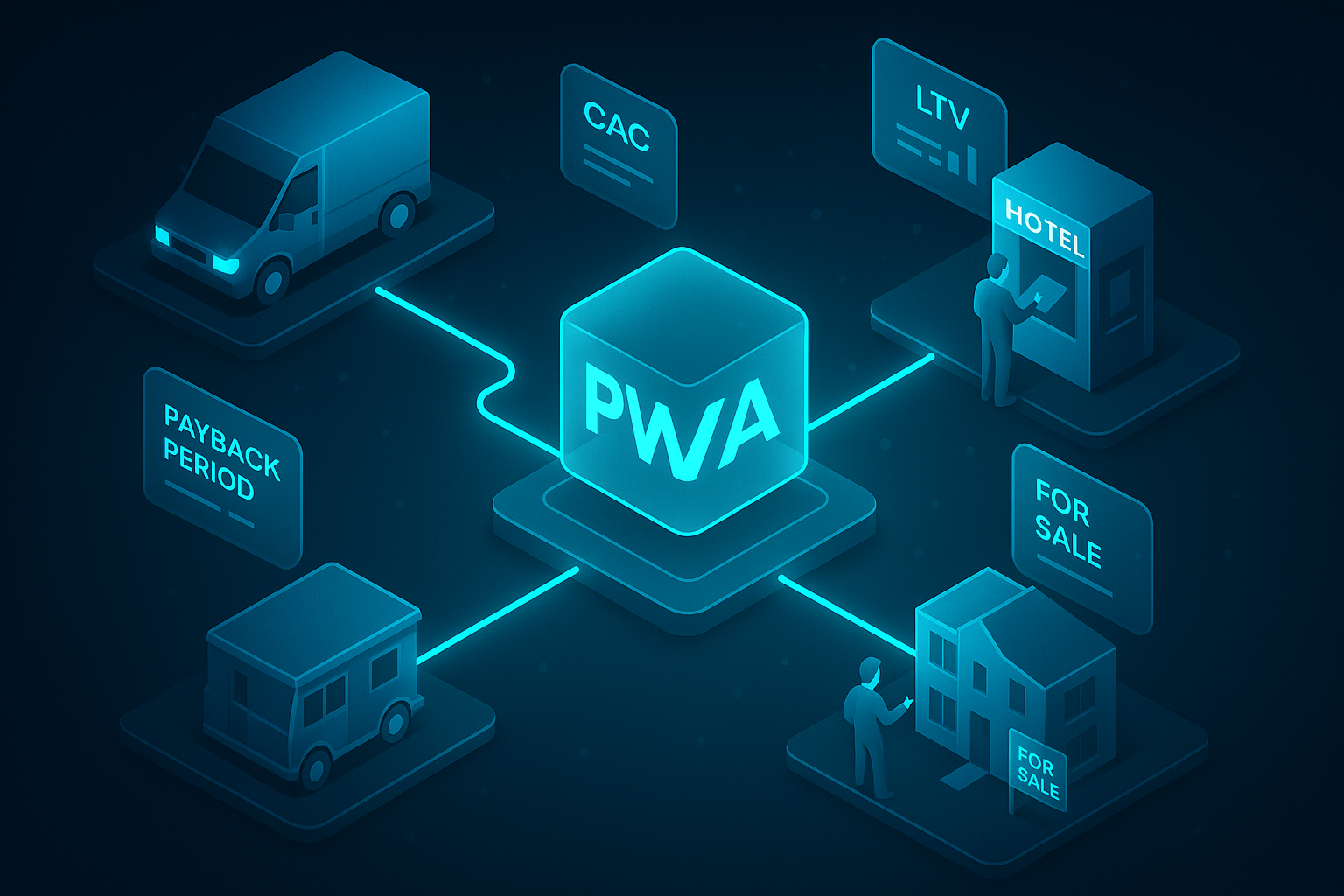
- Hospitality pre check in: a Dubai hotel group used a PWA to capture passport scans and deposits before arrival. Check in time dropped by 40 percent, front desk staffing was optimized, and upsells for late checkout increased by 18 percent.
- Logistics last mile: an Abu Dhabi fleet digitized driver manifests with a PWA that cached routes offline for desert zones. Failed deliveries fell by 12 percent and cash handling shrank by 30 percent after digital payments.
- Real estate viewings: a Sharjah brokerage deployed a PWA with instant media compression and calendar sync. No show rate decreased by 22 percent and agent utilization improved.
Breaking down the build timeline
- Discovery and scope alignment: 2 to 3 weeks. Success metrics, user journeys, technical plan, and prioritized roadmap.
- Design sprints and clickable prototype: 2 to 4 weeks. Visual system, interaction patterns, bilingual screens.
- MVP build for a PWA: 8 to 12 weeks. Core flows, analytics, payments, push, and admin.
- Scale phase: 3 to 6 months. Integrations, automation, BI dashboards, and performance hardening.
Parallel tracks for compliance, security testing, and store packaging reduce total lead time. The Bridge Technology uses a cadence of weekly demos, automated testing, and continuous delivery to keep risk low and stakeholders aligned.
Hidden costs to plan for in Dubai
- Cloud hosting and observability: database, CDN, error tracking, and uptime SLAs.
- Analytics: product analytics, heatmaps, and event governance.
- SMS OTP and email: registration and recovery flows, plus sender reputation management.
- Maps and geocoding: usage based billing for location heavy apps.
- Payment processing: gateway fees, fraud tools, and reconciliation workflows.
- Security and compliance: penetration testing, privacy impact assessments, PDPL readiness, and data residency where required.
- Localization: Arabic and English content, right to left QA, and customer support scripts.
- Store packaging and updates: Google Play and App Store review cycles and policy changes.
Team models and vendor selection
In house hiring increases fixed costs and time to scale. A pure offshore approach can drop rates but often adds coordination risk. A focused product partner in the UAE with clear accountability, on site presence when needed, and repeatable delivery practices offers the best blend of speed, quality, and cost.
The Bridge Technology delivers small senior squads that cover strategy, UX, engineering, QA, and growth. We align to business outcomes, ship early, and measure impact. Explore our App Development capabilities, our modern Website Development stack for PWA speed, and pragmatic AI Solutions that power personalization and smart automation.
Trends shaping 2026 app budgets
- AI copilots inside apps: natural language flows reduce clicks, raise conversion, and cut support load. Expect an uplift in build cost that pays back through self service and better retention.
- Passkeys and secure sessions: passwordless flows improve sign in rates and reduce fraud risk.
- Edge and serverless: lower latency for users in Dubai and Abu Dhabi, plus pay per use economics.
- WebAssembly acceleration: near native performance for rich media and data heavy features inside a PWA.
- First party growth: push notifications, owned audiences, and content that reduces dependency on paid channels.
Each trend supports the PWA first thesis. You gain performance and reach without duplicating codebases, and you keep optionality to add native shells only where there is true device depth.
Cost control playbook without cutting corners
1. Narrow the MVP to a revenue or savings slice
Pick one job to be done that proves value. For a marketplace, that might be listing creation and checkout with one payment method. For a field ops app, that might be route assignment and proof of delivery photos. Everything else waits for post launch data.
2. Use a PWA core with native packaging as needed
Deliver the app as a PWA that users can install and that is eligible for Google Play and the App Store. Add native wrappers only where store policy or device depth requires it.
3. Buy, do not build, the undifferentiated stack
Identity, payments, analytics, messaging, and content management are commodity. Choose stable services with UAE friendly compliance. Invest custom engineering where it moves the P and L.
4. Instrument everything
Define a single source of truth for metrics: activation, retention, order rate, refund rate, task completion, and page performance. Use this data to prune low value features and double down on winning flows.
How The Bridge Technology delivers
We move from discovery to measurable business outcomes, not just tickets closed. Our approach includes:
- Outcome aligned discovery that converts strategy into a prioritized roadmap and a defensible budget.
- Design systems that respect Arabic and English, and a11y standards for broader reach.
- Performance first PWA engineering with caching, offline readiness, and secure APIs.
- Automated testing and continuous delivery for predictable releases.
- Growth loops, analytics governance, and a content engine linked to Digital Marketing and Advertising when needed.
- Post launch care with proactive Support and clear SLAs.
View results in Our Portfolio, including commerce, logistics, hospitality, and real estate products across Dubai, Sharjah, and Abu Dhabi.
Budget snapshot to take into your morning standup
- If your goal is to validate a new product, allocate AED 100,000 to 250,000 for a high quality, installable PWA MVP in roughly three months.
- If your goal is post product market fit scale, expect AED 200,000 to 500,000 for deeper integrations, analytics, and automation over the next two quarters.
- Plan 15 to 25 percent yearly for operations and ongoing improvement. Protect capacity for experimentation, not only maintenance.
The fastest path to ROI uses a PWA core, proof in weeks, and store presence without the cost of two or three parallel codebases. That is our specialty at The Bridge Technology.
Ready to map your cost, timeline, and ROI with precision, and ship an installable app that feels native across platforms and devices in the UAE and beyond? Contact Us for a free planning session today.
Keywords: cost of app development in Dubai, app development pricing UAE, PWA vs native cost, mobile app ROI Dubai, software budget UAE, Dubai tech trends, MVP app cost