Cost of App Development in Dubai: ROI and 2026 Playbook | The Bridge Technology
See realistic app development costs in Dubai, ROI models, and cost savers. Learn how PWAs cut spend and speed launch. Talk to The Bridge Technology today.
A clear, CEO level breakdown of app development costs in Dubai, with ROI models, cost reduction levers, and 2026 trends. See why PWAs deliver faster payback.
Category: Mobile Apps
Key Takeaways
- Typical Dubai app budgets: MVP from AED 150k to 350k, scale up from AED 400k to 1.2m, enterprise from AED 1.2m plus.
- Progressive Web Apps cut cost and time by 25 to 40 percent and can be installed from Google Play and App Store when packaged correctly.
- ROI improves when you launch a PWA first, validate traction, then invest in native features where they truly pay back.
- Core cost drivers: scope, integrations, security, cloud, and team seniority. Design and QA maturity reduce rework significantly.
- New gains in 2026: AI copilots for support and analytics driven roadmaps that retire low value features early.
For CEOs and founders in Dubai, Sharjah, and Abu Dhabi, the right question is not only what an app costs, it is how quickly that investment returns cash. This guide brings clarity on what drives the cost of app development in Dubai, how to model ROI with confidence, and which moves reduce spend without cutting quality.
What really drives the cost in Dubai
The UAE market rewards quality and speed. Cost is shaped by a handful of controllable levers.
- Scope definition: A crisp problem statement and a lean first release keep the team focused. Most overages start with vague scope.
- Platform decisions: PWA, native iOS and Android, or a combined path. Many Dubai businesses start with PWA to validate, then double down on native where device features are essential.
- Integrations: Payment gateways, ERP, inventory, CRM, delivery partners, and UAE digital identity can be simple or intricate. Every external dependency adds effort and risk.
- Security and compliance: UAE PDPL, PCI DSS for cards, and sector specific rules add architecture and audit work, yet they also protect brand equity.
- Content and localization: Arabic and English parity, right to left support, and culturally tuned UX increase effort but expand reach.
- Cloud architecture: Serverless patterns, autoscaling, and managed services save long term cost but require upfront design skill.
- Team seniority and process: Strong product management, seasoned engineering, and rigorous QA reduce rework and defects after launch.
Indicative ranges for new builds in Dubai, assuming a commercially viable scope and premium execution:
- Lean PWA MVP: AED 150k to 350k across 8 to 12 weeks.
- Cross platform app with payments, notifications, analytics, and two to three integrations: AED 400k to 1.2m across 3 to 7 months.
- Enterprise scale with complex workflows, role based access, offline sync, and advanced security: AED 1.2m to 3m plus across 6 to 12 months.
These ranges reflect project complexity and team mix. A security centric fintech or health app sits at the higher end, while a focused marketplace pilot can land near the lower end.
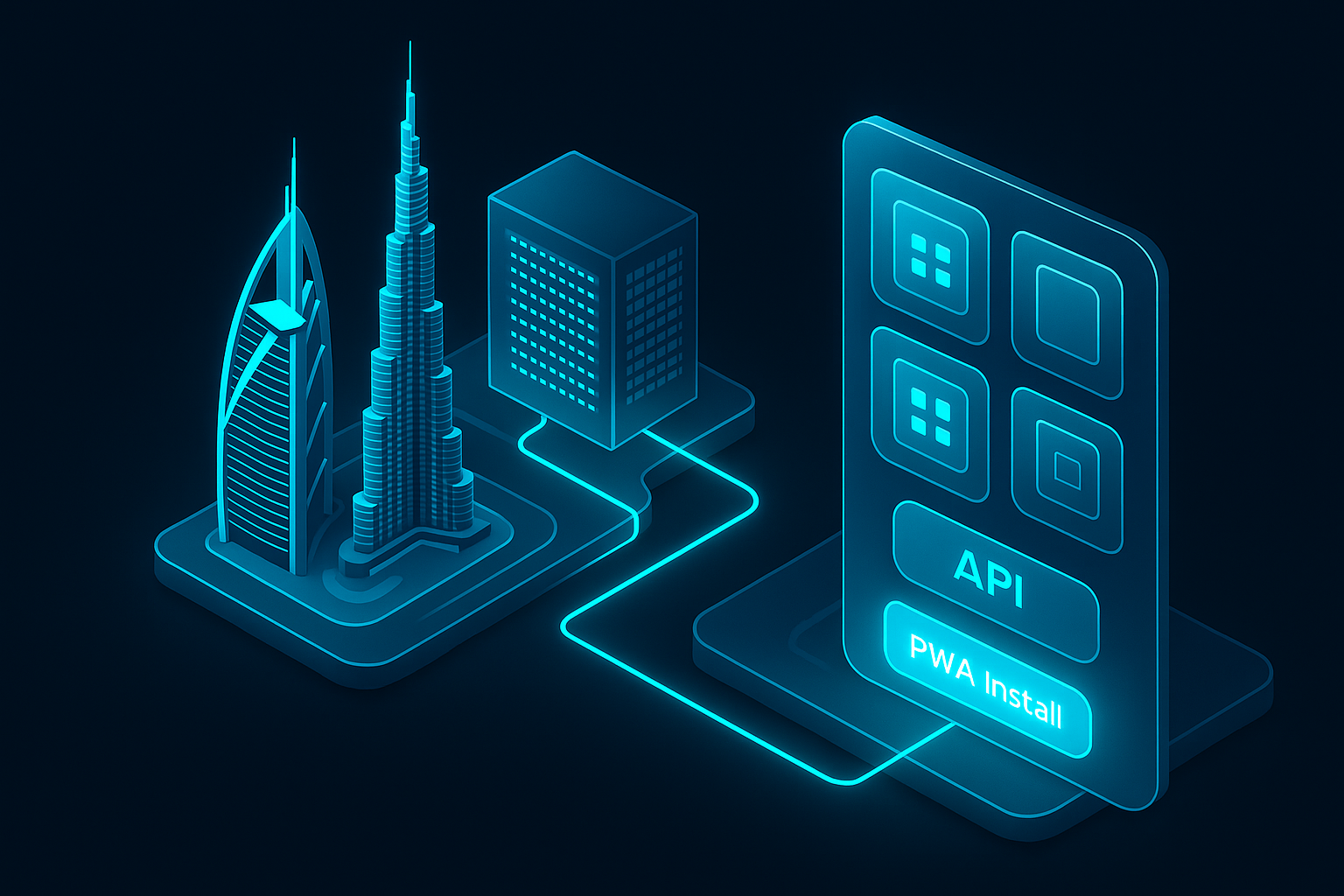
PWA first: better ROI, faster market entry
The Bridge Technology specializes in Progressive Web Apps that look and feel like native mobile apps. They can be installed from Google Play and App Store when packaged with the right approach, and they run in a secure browser layer with offline capability, background sync, and push notifications.
Why this matters for cost and ROI:
- One codebase: Build once, reach mobile and desktop, and iterate faster. This can reduce development cost by 25 to 40 percent versus two native stacks.
- App like UX: Splash screens, icons, install prompts, and smooth navigation deliver a premium feel for your customers.
- Faster approval path: You can launch on the web instantly, then add store presence using trusted packaging, which shortens time to first revenue.
See how we deliver this with our App Development approach and the engineering depth that powers our Website Development stack.
ROI model that CFOs trust
Quantify ROI before you invest. A simple model aligns your board and protects your capital.
Inputs
- Acquisition: organic installs and paid per install cost, driven by your brand and performance marketing.
- Conversion: install to first transaction or key action rate.
- Monetization: average order value, take rate, or subscription price and tenure.
- Retention: month one, three, and six retention percentages.
- Cost to serve: cloud, support, and operations per active user.
Outputs
- LTV to CAC ratio: aim for 3 to 1 or higher after month six.
- Payback period: under 9 months for growth plays, under 18 months for regulated or enterprise cases.
- NPV: discount future cash flows at your hurdle rate, often 12 to 18 percent in growth portfolios.
Example from the UAE market: a retail group launches a PWA for click and collect. With AED 250k build cost, AED 60k quarterly cloud and support, and AED 10 per install from paid performance, they reach 30k installs in four months. A 6 percent conversion to purchase at AED 160 average basket and 30 percent gross margin yields a payback in month seven. Moving to native features for store staff scanning then saves two minutes per order in operations, which adds a second ROI stream through cost reduction.
We frequently enhance ROI using personalization and predictive flows powered by our AI Solutions, such as next best action nudges, demand forecasts, and AI driven search.
Real UAE scenarios and budgets
- Clinic network in Sharjah: appointment booking, telemedicine through secure web rtc, and staff roster sync. PWA first in Arabic and English. AED 300k to 550k across 12 to 18 weeks. ROI comes from reduced no shows and higher clinician utilization.
- Logistics SME in Jebel Ali: driver app for proof of delivery, barcode scanning through camera, and dispatcher console. PWA for rapid field rollout, later adding a thin native wrapper for background tasks. AED 450k to 900k. Savings appear as lower failed deliveries and faster invoicing.
- Hospitality group in Dubai Marina: loyalty app with offers, geo triggered messages, and e wallet. Start with a PWA and move high value modules to native. AED 600k to 1.2m. Increased repeat visits lift gross margin within two quarters.
Cost reduction levers without cutting quality
- Phase intelligently: launch a Minimum Lovable Product that solves one painful job, then expand with data. Avoid building rarely used features.
- Design once, ship many: use a shared design system and component library. This reduces frontend effort by 20 to 30 percent.
- API first: stabilize data contracts with your ERP or CRM early. Integration churn is the silent budget killer.
- Serverless and managed services: fewer servers to patch, autoscaling by default, and pay per use economics.
- Automated testing: unit, integration, and device tests catch regressions, saving late stage firefighting.
- Telemetry and analytics: track funnel drop off, performance, and crashes from day one. Kill low value features quickly.
- Shared operations: our Support plans cover monitoring, incident response, and continuous improvements at a predictable monthly rate.
Security, compliance, and data residency in the UAE
Security is a board level risk in the GCC. Budget for it deliberately:
- Compliance: UAE PDPL, tokenization for payments, and sector rules for health and finance. Align with international standards to ease audits.
- Data residency: select cloud regions that meet enterprise policy. Use encryption in transit and at rest, key rotation, and privileged access controls.
- Threat modeling and pen tests: design for least privilege, rate limits, and structured logging. Schedule regular pen tests before major releases.
Vendor checklist for CEOs
Choose a partner that thinks in outcomes, not only tickets. Use this checklist during procurement:
- Showcase relevant work in the GCC that demonstrates scale, security, and measurable ROI. Browse Our Portfolio.
- Architecture clarity: ask for a one page diagram and a simple risk register that covers integration and compliance concerns.
- Product discipline: insist on roadmaps tied to metrics, not only feature lists.
- Transparent pricing: time and materials with visibility, or milestone structure with clear acceptance criteria.
- Operating model: agreements for SLAs, observability, and release cadence. Confirm how changes flow through environments.
- Team: named senior talent on product, design, and engineering, with references you can call.
Timeline and team structure
Expect 8 to 12 weeks for a lean PWA MVP and 4 to 7 months for a feature rich product. Timelines tighten when scope is sharp and business decisions are fast. A typical team includes a product manager, UX and UI designer, tech lead, two to five engineers across frontend and backend, a QA lead, and a DevOps specialist. For computer vision, personalization, or chat assistants, we add an AI engineer and data specialist from our AI Solutions team.
Trends shaping costs through 2026
- AI inside the app: conversational flows for service, smart search, and anomaly detection reduce support tickets and raise conversion.
- Edge and offline first: smarter caching and local processing deliver snappy performance for field teams and retail floors.
- Composable backends: micro frontends and modular services allow you to upgrade parts of the system without expensive rewrites.
- Privacy by design: first party data collection, consent tools, and clean room analytics become table stakes for growth and compliance.
- UAEPASS and open banking: smoother onboarding and trusted payments lift conversion and shrink fraud losses.
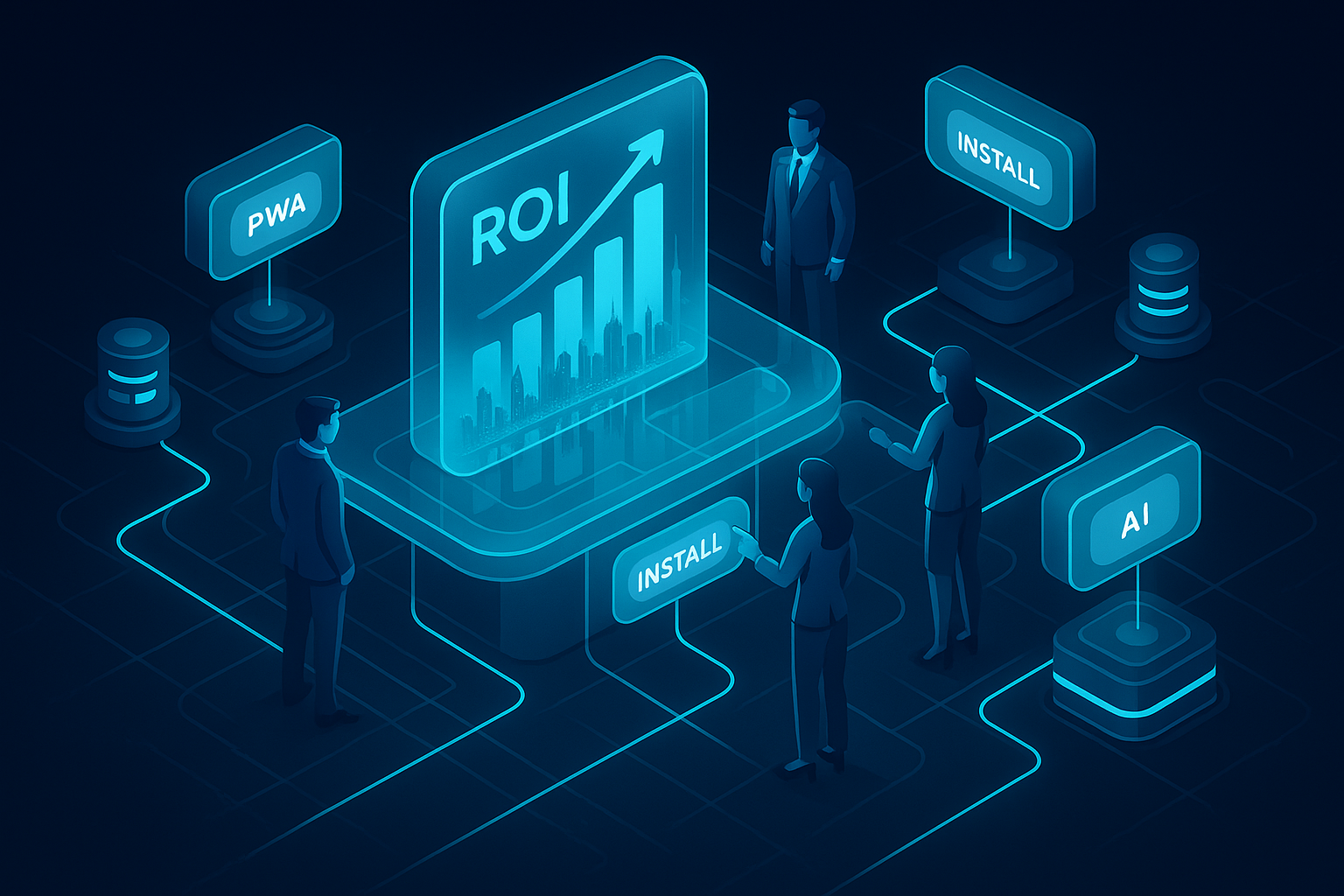
Budget scenarios you can act on
- Lean validation: customer facing PWA with core journey, analytics, and one payment method. AED 150k to 300k. Expect 8 to 12 weeks.
- Growth engine: PWA plus packaged store presence, notifications, loyalty, two to three integrations, and data warehouse feed. AED 400k to 900k. Expect 3 to 6 months.
- Enterprise transformation: role based apps for customers and staff, offline workflows, SSO, complex reporting, and advanced security. AED 1.2m to 3m plus. Expect 6 to 12 months.
Along the way, use our Digital Marketing team to accelerate acquisition and reduce your cost per install, while our Website Development and App Development squads deliver a single, high quality codebase that scales.
Why The Bridge Technology
- PWA mastery: we build web experiences that feel native, install easily, and pass store requirements when packaged correctly.
- Speed with rigor: design systems, automation, and observability by default. Fewer regressions, faster market entry.
- ROI focus: product decisions led by data, not opinion. Roadmaps tied to revenue lift and cost to serve reduction.
- UAE context: bilingual UX, local payment stack, and regional compliance baked into the architecture.
Ready to model your ROI and budget with precision
Let us scope a PWA first plan that hits your revenue goals sooner and keeps total cost of ownership under control. Share your objectives and constraints, and we will return a clear proposal with timelines, architecture, and a path to app store presence where it adds value. Contact Us to start your estimate today.
Keywords: app development cost Dubai, PWA Dubai, mobile app ROI UAE, software budget UAE, progressive web app, Dubai tech trends, digital transformation UAE