Next.js vs React for Modern Web Development in UAE | The Bridge Technology
Compare Next.js and React for speed, SEO, and scalability. Choose the right stack for UAE projects and PWAs. Build with The Bridge Technology. Contact us today.
Choosing between Next.js and React can define your speed, SEO, and growth path. Here is a clear, developer focused guide with UAE examples and a practical decision flow.
Category: Web Development
Key Takeaways
- React is a flexible library for building UI. Next.js is a full stack framework that adds routing, server side rendering, static generation, and edge delivery.
- Choose React when you want a minimal setup and total control. Choose Next.js when you need speed, strong SEO, fast routing, image optimization, and built in rendering strategies.
- For commerce, content, and lead generation in Dubai and Abu Dhabi, Next.js often delivers better discovery, faster pages, and more reliable growth.
- The Bridge Technology builds Progressive Web Apps that feel like native apps and can be listed on major app stores. Next.js amplifies that experience with performance and reliability.
- Start lean with React for prototypes. Migrate to Next.js when you need server rendering, incremental static regeneration, or a single code base across web and app experiences.
Evening hours are often when builders sharpen tools and ship. If you are weighing Next.js or React for a new project in Dubai, Sharjah, or Abu Dhabi, the choice affects performance, SEO, and long term maintainability. This guide makes a crisp comparison for busy engineers and product leaders, with a focus on how each path plays out for real businesses in the UAE.
At The Bridge Technology, we create high performance websites and Progressive Web Apps that act like native mobile apps. Our products can be installable from major app stores, which is a practical path for many brands that want broad reach without the heavy cost of two separate native builds. Whether your team runs React or Next.js today, we align the stack with your growth plan, then ship.

React and Next.js in plain terms
React is a library. It gives you components, state, and a fast virtual DOM. You bring the router, build system, and data strategy. It is lean and unopinionated, which suits teams that love to compose their own tool chain.
Next.js is a framework that sits on top of React. It provides a file system router, server side rendering, static generation, incremental static regeneration, API routes, image optimization, and easy deploys to modern hosting. You can still write React components, but you also gain rendering control and smarter delivery with minimal setup.
Performance and SEO that compounds
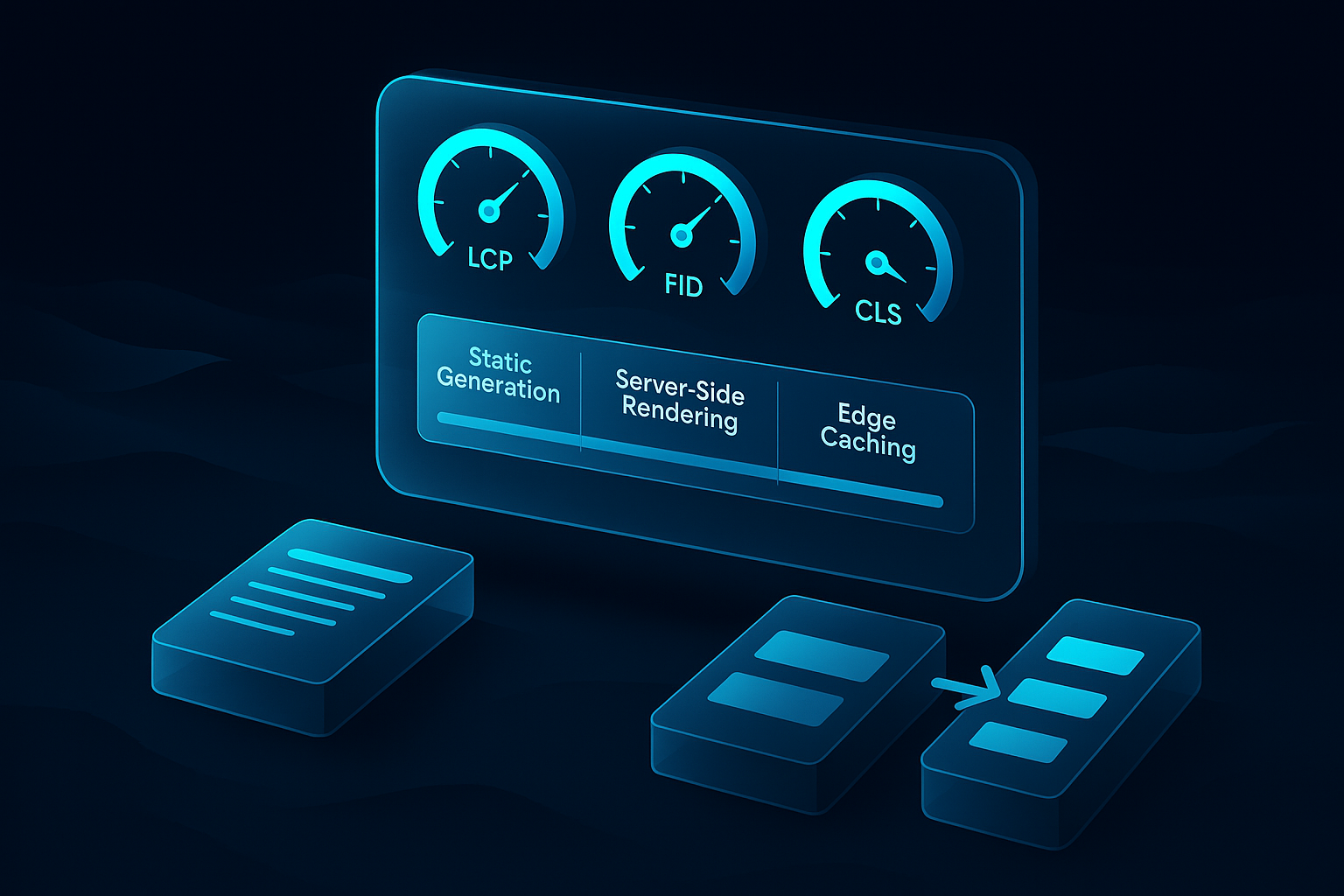
Speed and discovery drive B2B pipelines and retail conversions. React by itself renders in the browser, which is fine for apps behind login, dashboards, and tools. For public pages that must be crawled and ranked, server side rendering and static generation give you content on the first paint and cleaner HTML for search bots.
Next.js lets you choose the right mode per page. Landing pages can be static with regeneration for fresh content. Product pages can be generated on demand with cache. Account pages can render on the server for secure and fast data loading. This flexibility keeps your bundle lean and your metrics strong.
In Dubai retail, a bilingual store that needs rapid catalog updates and strong SEO will usually benefit from Next.js. Static generation with regeneration creates instant pages in both languages while keeping inventory data fresh. React alone can deliver this too, but it will require custom wiring for prerendering and caching that Next.js already solved.
Developer experience and architecture
React is perfect when your team prefers focused libraries and a custom build. If you are building a small widget, internal tool, or a reusable component library, React with a light router and Vite can be ideal.
Next.js offers a cohesive developer experience. Routing, data fetching conventions, image optimization, font loading, and environment management are all organized. Modern Next.js also supports React Server Components for smarter splits and faster first interaction. The result is less glue code and more time on features.
Routing and data fetching that scale
React has great routers in the ecosystem. You pick one, define routes, and then decide how to fetch data per route. This is flexible but requires decisions that can vary across teams.
Next.js uses a file based router. Place a file in the routes folder and you have a route. Layouts, templates, and nested routes ship with consistent patterns. Data fetching can run on the server with secure access to secrets and clean hydration of the client. This reduces client side fetch chatter and improves perceived speed.
Progressive Web Apps and app store reach
The Bridge Technology specializes in building web experiences that feel like native apps. With the right service worker, caching, offline strategy, and push messaging, you get install prompts and a seamless touch experience. We also package web apps for listing on major app stores, giving you a single code base that reaches web, Android, and iOS through approved channels.
Next.js strengthens this with static assets, route level caching, and server rendering flexibility. For example, a Sharjah event platform can load schedules offline, cache venue maps, and update sessions in the background. The experience feels native, yet runs from a single web stack.
Explore how we approach this in our Website Development and App Development services, and see live examples in Our Portfolio.

Security and compliance in the UAE context
Many sectors in the UAE require secure data handling. Healthcare portals in Abu Dhabi must protect records. Financial services in DIFC must meet strict governance. Next.js lets you move sensitive operations to the server through API routes and server components, with secrets stored on the server and not shipped to the client. React can do this with a separate backend, but Next.js offers a tidy in one framework pattern that reduces mistakes and improves observability.
When to choose React
- You are building a small widget or embedded module that will live inside an existing system.
- You want total control over the build and enjoy curating every library.
- You have a private internal tool where SEO is not a priority and client side rendering is acceptable.
When to choose Next.js
- You need excellent SEO for public pages and want to control rendering per route.
- You want a clear path to a Progressive Web App that feels native and can be listed in app stores.
- You prefer a consistent architecture across teams with less glue code and faster onboarding.
- You plan to scale content across languages and markets in the UAE and beyond.
UAE examples that guide the decision
Dubai luxury retail
A multilingual catalog with fast product pages and editorial stories will thrive with static generation plus regeneration. Next.js delivers stable performance on catalog pages and dynamic rendering for cart and profile. Paired with our Digital Marketing service, you get content velocity and measurable growth.
Abu Dhabi healthcare portal
Protected records, appointment booking, and secure messaging benefit from server components and API routes. Next.js keeps sensitive logic on the server and simplifies access control. For triage chat or appointment prediction, our AI Solutions integrate safely into the server workflow.
Sharjah events and ticketing
Visitors want fast schedules and offline maps during a conference. A Next.js based PWA gives instant navigation, background sync, and smooth check in. We connect payments and analytics, then ship updates without long review cycles. If your team needs steady guidance post launch, our Support plans keep things fast and secure.
Implementation playbook
- Define page types and goals. Public pages focus on SEO and speed. Auth areas focus on security and interaction.
- Pick rendering per route. Use static generation for stable content. Use server rendering for personalized or fast changing pages. Use incremental static regeneration when content updates on a schedule.
- Plan global performance. Optimize images with the built in image component. Load fonts efficiently. Trim client side JavaScript and move logic to the server where possible.
- Design a PWA strategy. Configure service worker caching for app shell and critical pages. Support offline search where useful. Add web push for engagement.
- Deploy with modern hosting. Use edge functions for geo routing, which is valuable for UAE localization. Monitor with real user metrics and iterate.
Common pitfalls and how to avoid them
- Over shipping client code: Move data loading to the server. Use server components for heavy logic. Keep bundles small.
- One size fits all rendering: Choose rendering per page. Your homepage is not the same as your dashboard.
- Ignoring image and font budgets: Use the image optimizer and modern formats. Preload only what is essential.
- Forgetting mobile install: If reach is a priority, plan your PWA from day one. The Bridge specializes in installable experiences that feel native.
Cost and timeline signals
If your team already maintains a React router, custom prerender scripts, and a patchwork of build tools, moving to Next.js can reduce maintenance and speed up releases. For greenfield projects that need SEO, multilingual content, and app like behavior, Next.js usually ships faster with fewer surprises. For component libraries and small embeds, plain React keeps the footprint minimal.
We assess these tradeoffs during discovery and align stack choices with your business goals. Our Website Development and App Development teams collaborate to deliver a single experience across web and app stores, backed by analytics and iteration from our Digital Marketing specialists.
A simple decision guide
- If SEO and fast first paint are critical, start with Next.js.
- If you need an installable app like experience without two native builds, choose Next.js and a PWA plan.
- If you have a small, embedded UI or an internal tool with no SEO needs, plain React is a fine choice.
- If your team wants a single standard across multiple squads, Next.js reduces variance and improves onboarding.
Build with The Bridge Technology
The Bridge Technology delivers modern web experiences that look premium, run fast, and convert. We partner with ambitious teams in Dubai, Sharjah, Abu Dhabi, and global markets. See what we have shipped in Our Portfolio. If you are ready to pick a path and accelerate, Contact Us and let us architect a future ready stack for your next release.
Keywords: Next.js, React, server side rendering, static site generation, Progressive Web Apps, UAE web development, B2B websites