ROI of PWA vs Native Apps for UAE Businesses | The Bridge Technology
Discover how PWAs outperform native apps on ROI for UAE firms. Compare costs, timelines, and retention, then book a consult with The Bridge Technology.
For UAE CEOs and founders, the fastest route to mobile ROI is rarely a full native build. See how Progressive Web Apps reduce cost, compress timelines, and unlock installability from app stores while preserving a premium experience.
Category: Mobile Apps
Key Takeaways
- PWAs cut total cost of ownership by thirty to fifty percent for most UAE use cases due to one codebase and web delivery.
- Time to first value is faster with PWAs, measured in weeks rather than many months, which compounds ROI by bringing revenue and savings forward.
- Modern PWAs are installable, work offline, send push notifications, and can be listed on Google Play and the Apple App Store using compliant wrappers.
- For ecommerce, bookings, loyalty, and internal tools, PWAs match user expectations while reducing acquisition and maintenance costs.
- Native still wins for heavy graphics, deep hardware integrations, and advanced sensor features, although a hybrid approach can balance reach and performance.
Morning decisions set the tone for the quarter. If you lead a brand in Dubai, Abu Dhabi, or Sharjah, and you need mobile reach without runaway cost, the ROI question is simple: where will the next million dirhams work harder, a Progressive Web App or a full native stack for iOS and Android. This guide is built for CEOs and founders who want numbers, not noise.
How to measure ROI for mobile in the UAE context
Before choosing PWA or native, align on a common ROI model. The variables are consistent across sectors from retail to real estate, although their weights change by strategy.
- Initial build cost: design, engineering, integrations, testing, and store compliance if needed.
- Ongoing cost: hosting, updates, security, OS changes, and device specific refactoring.
- Time to market: earlier launch brings revenue forward and reduces opportunity cost.
- Acquisition cost: web install prompts and deep links reduce friction compared with store only discovery.
- Retention and engagement: push notifications, offline access, and app like speed drive repeat use.
- Conversion rate: checkout and booking performance, biometrics, Apple Pay and Google Pay, autofill, and one tap login.
- Compliance and security: data residency, consent, encryption, and audits.
What a PWA is today
PWAs deliver app like speed and interactivity through the browser using a service worker, a web app manifest, and modern APIs. They install to the home screen with an icon, open in a standalone window, work offline for core flows, and can show timely push notifications. With The Bridge Technology you also get store presence. We package PWAs for Google Play using Trusted Web Activity and for the Apple App Store using native wrappers that pass store guidelines, which preserves one codebase while unlocking store discovery.
Our core differentiator is simple. We build websites that behave like native apps, and we make them installable from app stores. You keep the speed of the web and the reach of the stores without the usual double build burden.
Cost and timeline comparison
Every project is unique, although patterns are consistent across our UAE engagements.
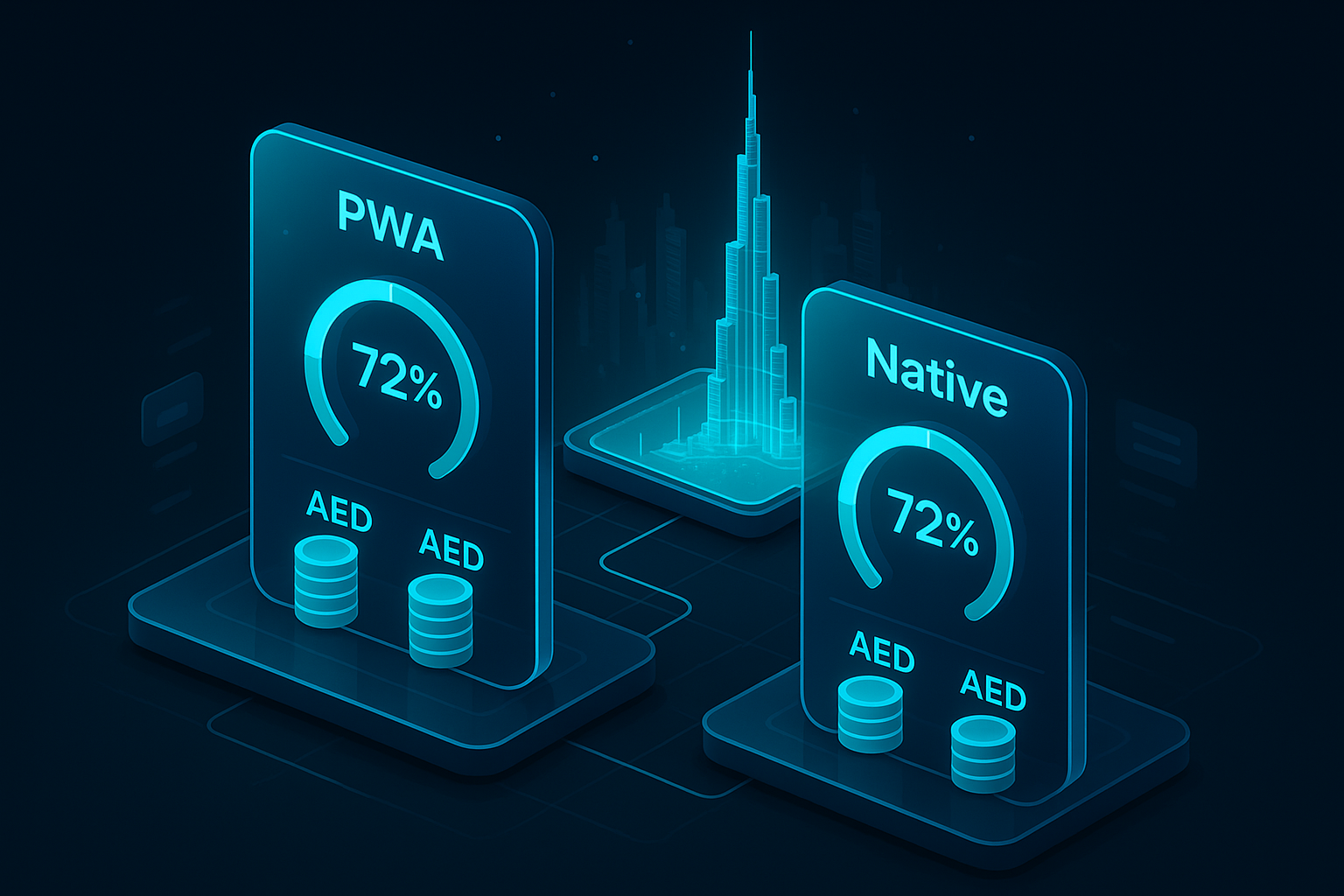
- Initial build: a robust consumer PWA with payments, analytics, and CRM integration typically lands between two hundred thousand and five hundred thousand AED. A comparable native approach for iOS and Android often doubles that due to two codebases and parallel QA.
- Timeline: a retail or F and B PWA often ships in six to ten weeks including design sprints and UAT. Comparable native builds routinely exceed sixteen weeks because of dual stacks and store reviews.
- Ongoing costs: PWAs usually save thirty percent or more per year on maintenance since updates deploy once to the web and propagate to store packaged versions without duplicate work.
These savings accelerate payback. If your target is break even in three to six months, a PWA is usually the safer path unless your product depends on advanced device features that the web does not yet expose.
Real cases from the UAE market
Dubai fashion retailer: faster checkout and lower acquisition cost
A mid market fashion brand in Dubai migrated from a mobile site and a stalled native roadmap to a PWA. After launch, add to home screen adoption reached twenty two percent of monthly visitors, push notification opt in hit thirty one percent, and checkout conversion lifted by eighteen percent due to faster page transitions and Apple Pay on the web. Cost per install from search and social moved from paid store installs to organic web to app prompts, which reduced acquisition cost by thirty five percent. The PWA was later listed on Google Play and the Apple App Store using wrappers, which captured users who still prefer store discovery.
Abu Dhabi healthcare group: bookings that work offline
A healthcare provider needed appointment booking in areas with patchy coverage. The PWA cached clinician schedules and allowed patients to submit forms offline, then synced when a connection returned. No more stranded sessions. The result was a measurable drop in call center volume and a faster triage flow. Security was handled with TLS, strict content security policies, and anonymized analytics. Store presence supported staff engagement and patient trust.
Sharjah quick service dining: loyalty with push and QR
A quick service dining chain in Sharjah launched a PWA loyalty program with QR earn and burn, web push promotions, and offline wallets for points. The team avoided dual native builds and re invested the savings into menu photography and creator led content, which magnified ROI across channels.
If you want to see related builds, browse Our Portfolio then connect with our team for a tailored forecast.
Where native still leads
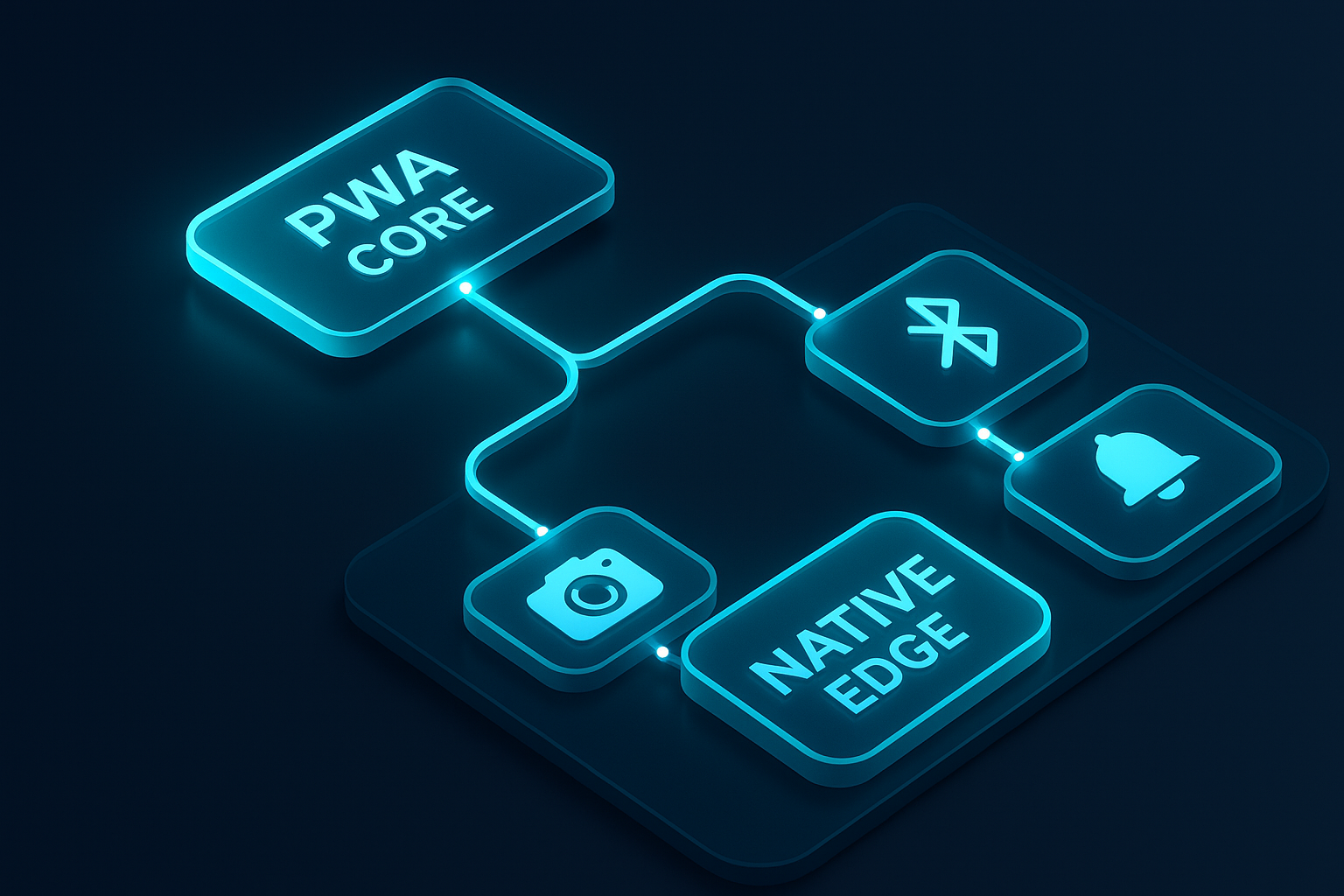
Native remains the right choice when your product relies on heavy three dimensional graphics, advanced camera pipelines, deep Bluetooth, or background services beyond current web capabilities. In these edge cases we often recommend a hybrid path. Build the core experience as a PWA for reach and speed, then add a light native shell with the exact hardware integrations you need. This keeps one source of truth for most features while capturing native only capabilities where they matter.
Acquisition, retention, and revenue impact
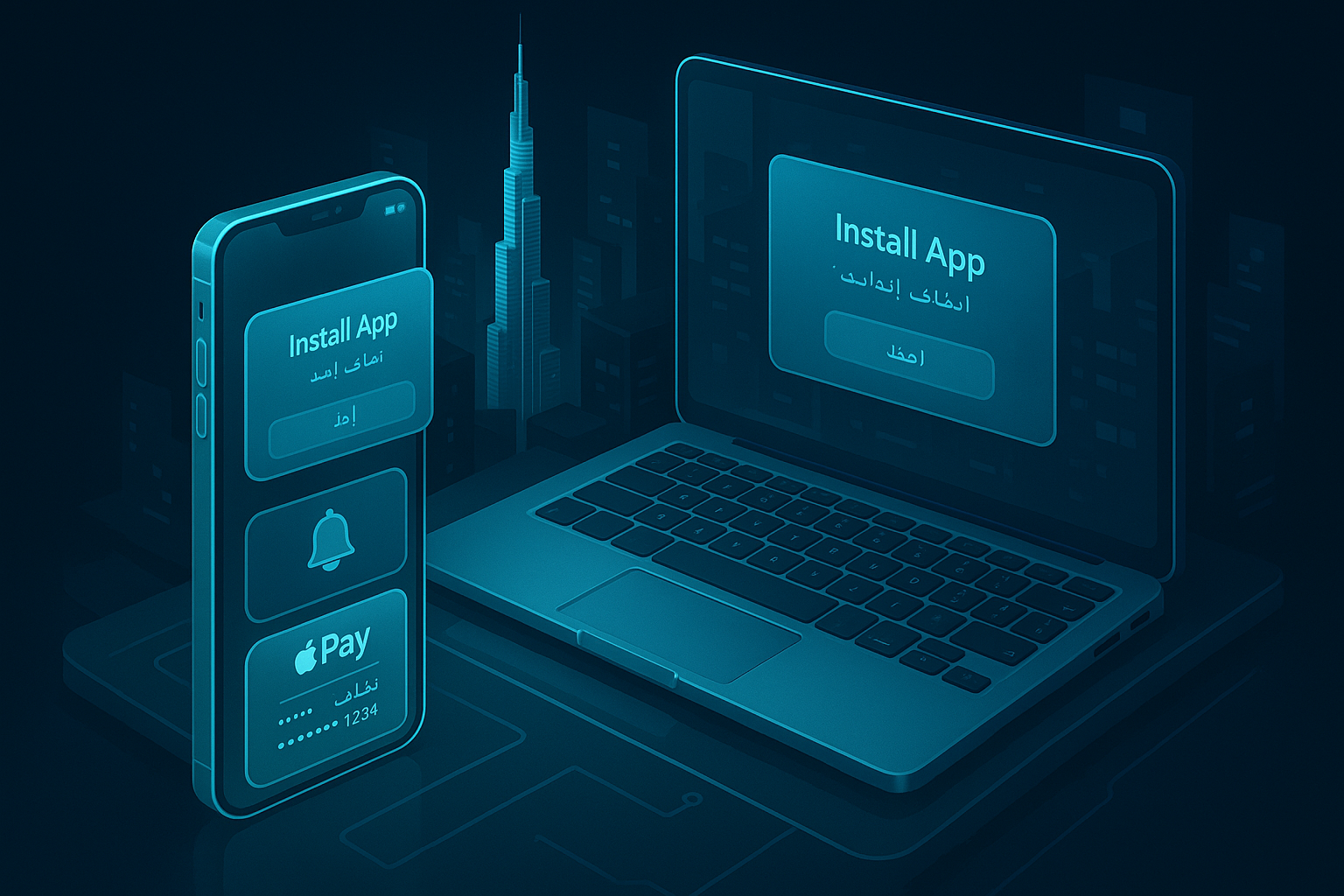
- Install prompts: PWAs can surface app banners on the web and inside store packaged versions. The prompt appears at the right moment, not buried behind a store page, which lifts install rate.
- Push notifications: web push now works on desktop and mobile across major browsers, including iOS support for web push. Target re engagement by segment and time zone, which is vital across GCC markets.
- Offline and performance: service workers cache assets and API responses, which reduces abandonment during travel, in elevators, and in basements.
- Checkout speed: modern web payments offer Apple Pay and Google Pay with tokenized cards and face or touch biometrics. Every second saved compounds conversion lift.
For growth teams, this unlocks a full funnel. Top of funnel lands on the web, mid funnel installs the PWA with minimal friction, and bottom funnel pays or books with one tap. Pair this with smart campaigns through Digital Marketing and performance Advertising to drive sharper ROI.
CFO level math: a simple ROI model
- Assume a PWA build of three hundred thousand AED, eight week delivery, and annual maintenance of fifteen percent.
- Assume a native dual build of seven hundred thousand AED, sixteen week delivery, and annual maintenance of twenty five percent.
- Revenue impact: with faster delivery, the PWA generates two extra months of revenue in year one. If monthly net contribution is one hundred thousand AED, that is two hundred thousand AED brought forward.
- Conversion lift: improved speed and one tap pay increase conversion by twelve percent. On ten million AED annual online sales, that is one point two million AED incremental before costs.
- Net of build and maintenance, the PWA payback can arrive within the first quarter after launch, while native may lag due to higher capex and slower go live.
Replace these inputs with your actuals. We can model this quickly in a workshop and align on targets.
Security, compliance, and governance
Security is not optional for UAE enterprises. PWAs support the same enterprise grade protections that banks and telcos already use on the web. We deploy content security policies, strict transport security, subresource integrity, and modern frameworks with vetted dependencies. For compliance, we align with local data handling guidelines and your internal audit controls. If you need mobile device management for staff tools, store packaged PWAs can be distributed privately with managed updates, and we provide continuous Support.
Why The Bridge Technology
- One team for strategy, design, engineering, and growth. Explore our Website Development and App Development practice.
- Deep PWA expertise with store compliant packaging for Google Play and the Apple App Store.
- Performance culture: Core Web Vitals, caching strategies, and edge delivery as standard.
- AI enhanced product analytics and personalization through our AI Solutions offering.
- Local understanding: Arabic support, regional payment methods, and GCC privacy expectations.
Execution playbook for CEOs
- Define the primary outcome: revenue, cost reduction, or customer experience. Pick one north star metric.
- Audit journeys: discovery, onboarding, purchase or booking, and support. Identify drop offs and performance gaps.
- Choose architecture: PWA first for most cases. Consider a hybrid wrapper if store presence is strategic or if you need limited native hooks.
- Pilot in one market or one product line. Measure install rate, push opt in, offline usage, and conversion lift.
- Scale with content and campaigns. Partner with our Social Media and Digital Marketing teams to compound reach.
- Plan twelve month governance: monthly releases, quarterly performance reviews, and semiannual UX refreshes.
The strategic bottom line
Native apps will continue to lead in specialist domains. For most UAE businesses that sell, book, or build loyalty, PWAs now offer the highest ROI per dirham invested. You launch faster, reduce total cost, and keep users in an installable, offline capable, push enabled experience that feels premium and modern. That is an advantage you can measure.
Ready to see the numbers for your brand. Schedule a rapid assessment with The Bridge Technology. We will scope a PWA or hybrid plan, model ROI, and outline a fast delivery path for Dubai, Abu Dhabi, or global rollout. Contact Us today.
Keywords: PWA ROI, native app cost UAE, progressive web app Dubai, mobile strategy CEOs, app store PWA, digital transformation UAE, The Bridge Technology