ROI of PWAs vs Native Apps for UAE Businesses | The Bridge Technology
See the real ROI of PWAs versus native apps for UAE firms. Lower cost, faster launches, higher retention. Book a strategy call with The Bridge Technology.
UAE leaders want growth that compounds without runaway cost. This analysis shows when PWAs outperform native apps on ROI, time to value, and retention. See real examples from Dubai, Abu Dhabi, and Sharjah.
Category: Mobile Apps
Key Takeaways
- PWAs often deliver 35 to 60 percent lower build cost and 30 to 50 percent lower maintenance cost compared to two native codebases.
- Time to value improves, teams launch in weeks not quarters, since one codebase serves web and app installs.
- Acquisition cost drops 20 to 40 percent through link based discovery, search visibility, and reduced install friction.
- Engagement rivals native with offline caching, push notifications, home screen install, and near instant load.
- Distribution flexibility is strong: publish on the open web and list on Google Play and App Store when needed.
- The Bridge Technology builds installable PWAs that behave like native apps and can ship to both major app stores.
Good mornings decide great quarters. If you lead growth in the UAE, you want a channel that compounds revenue without compounding cost. This briefing gives a pragmatic view of the return on investment of Progressive Web Apps versus fully native apps, tailored for executives in Dubai, Abu Dhabi, and Sharjah who want faster time to value and measurable savings.
What a PWA is today, and why UAE leaders should care
A Progressive Web App is a web application enhanced with service workers, an app manifest, secure contexts, and device integrations. Users can install it to the home screen, open it full screen, use it offline for many tasks, receive push notifications, and enjoy native like performance. Modern standards allow PWAs to access the camera, geolocation, file system scoped access, background sync, and more. With the right packaging approach, a PWA can also be listed on Google Play and Apple App Store, while still running from one shared codebase.
For CEOs and founders, a PWA offers one build that reaches desktop, mobile web, and app install pathways. That unifies product velocity, marketing reach, and support overhead. In the UAE market where speed of execution is a competitive advantage, this consolidation maps directly to better ROI.
The ROI model: four levers that matter
ROI for mobile experiences is governed by four primary levers. Build cost, time to value, acquisition and retention, and lifetime maintenance. Here is how PWAs stack up for most business cases in the region.
Build cost reduction
A typical native strategy requires two codebases, one for iOS and one for Android, often with separate skill sets and parallel quality assurance. A PWA consolidates this into a single high performance web codebase that also powers the website. In our App Development programs, this yields 35 to 60 percent savings on initial build for commerce, booking, media, and internal tools. When paired with modern component libraries and backend reuse through APIs, we can often deliver version one within eight to twelve weeks.
If your company is also replatforming the corporate site or landing funnel, the economics get better. One design system and one content layer power both site and app experiences. Our Website Development teams build PWAs that feel premium, load instantly, and share a core stack with your marketing site, which further reduces duplication of spend.
Time to first transaction
Speed compounds growth. PWAs cut time to value with two vectors. First, only one build is needed to reach every device through the browser, which eliminates store review gates during iteration. Second, users can install directly from the browser with a single tap, which removes the common abandonment that occurs while searching an app store. For app store presence, our packaging process submits the same PWA to Google Play and Apple App Store, preserving unified updates once the app is live.
Acquisition and retention economics
PWAs are linkable and indexable. That means every product, article, or offer is a landing page that can rank and convert. We consistently see lower cost per acquisition due to organic search and shareable deep links, especially when combined with Digital Marketing campaigns. Retention improves through fast load, offline support for key flows, and subtle install prompts after engaged sessions. Push notifications re engage lapsed users, and web push now works across Android and iOS in modern browsers.
When paid growth is required, PWAs integrate smoothly with Advertising and Social Media funnels. Clicks land on instant experiences, not store listings, which boosts conversion to first action. Post install journeys can still route to store badges when needed for brand cues.
Performance and capability parity
For the most common UAE use cases, including retail, loyalty, food delivery, appointment booking, news, real estate listings, and field operations, PWAs meet or exceed performance needs. Techniques such as service worker caching, prefetching, code splitting, and modern rendering pipelines deliver first interaction in sub second windows on mid tier devices. For advanced needs, we augment with native bridges only where essential, while preserving the main PWA codebase.
Compliance and distribution fit for the UAE
Enterprises in the UAE often require Arabic and English, strong accessibility, and data residency considerations. PWAs support bilingual content with a single routing layer and make accessibility easier to maintain. Distribution is flexible. You can operate a high velocity release cadence on the web, then package stable milestones for Google Play and App Store to satisfy enterprise distribution or brand standards. This hybrid path is a sweet spot for regulated and brand conscious sectors.
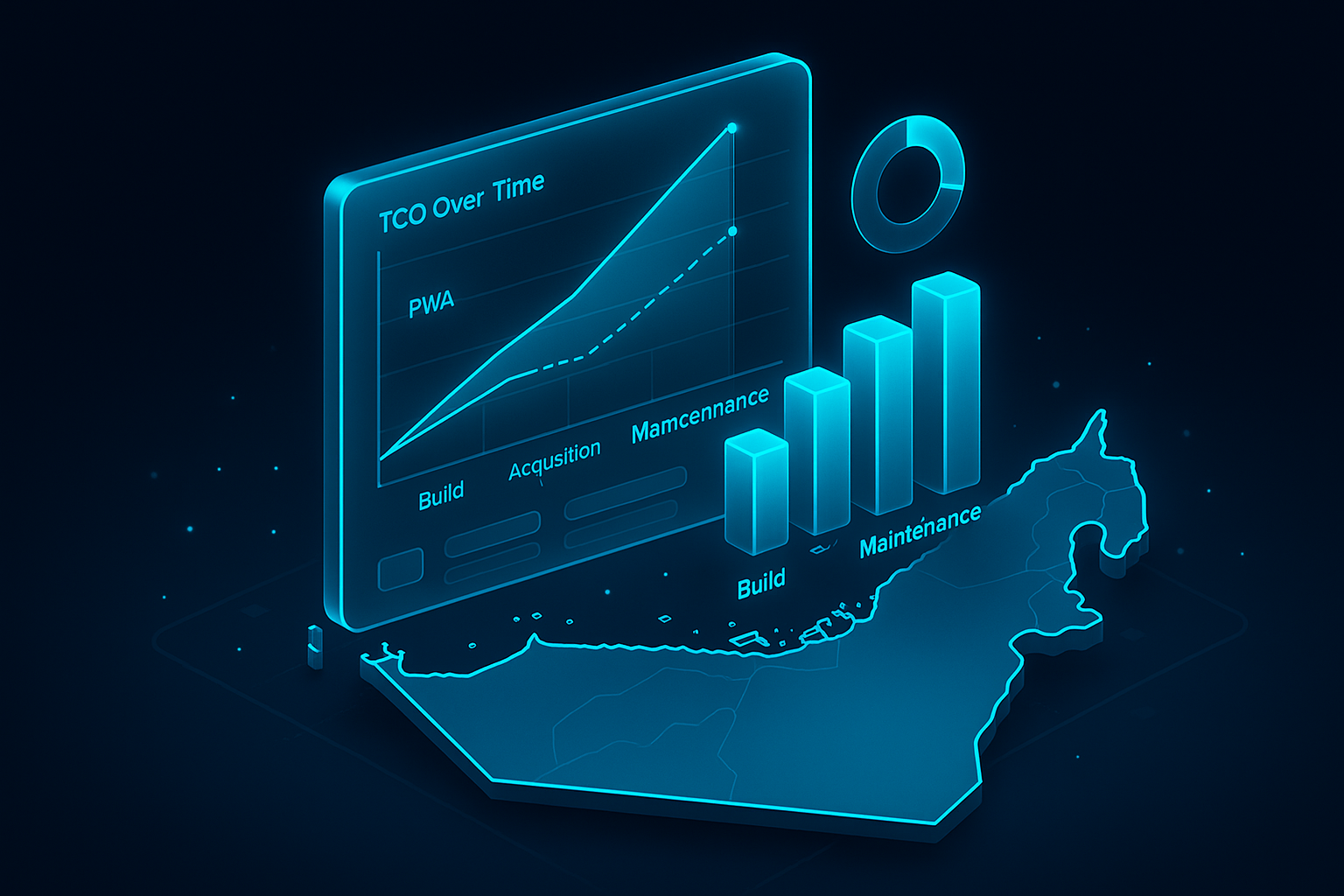
Total cost of ownership across five years
Native strategies pull double on every major line item. Product management must synchronize two roadmaps. Engineering must implement and test every feature twice. Security reviews and dependency updates are duplicated. Scaling and analytics pipelines become more complex. A PWA consolidates these concerns and turns many variable costs into a single shared investment.
Based on projects similar to those in Our Portfolio, a mid scale customer experience in retail or services can expect the following directional view. Initial build savings of 35 to 60 percent. Feature delivery cycle time down by 30 to 50 percent. Ongoing maintenance reduced by 30 to 50 percent. Acquisition cost trimmed by 20 to 40 percent due to direct web discovery. While exact numbers depend on brand strength and complexity, the directional slope is consistent across the region.
UAE case snapshots
Dubai retail chain, click and collect
A national fashion retailer in Dubai consolidated its mobile web and app into a single PWA. Results after three months. Add to home screen adoption at 22 percent of engaged visitors. Checkout conversion up 18 percent due to instant page loads and offline cart persistence. Paid acquisition cost down 27 percent as campaigns landed directly on product detail pages that were install capable. The same codebase was packaged for Google Play for brand coverage.
Abu Dhabi healthcare network, appointments and follow ups
A healthcare group launched a PWA for appointment booking and lab result access with bilingual support. New patient registrations grew 24 percent, and returning user sessions grew 31 percent once push reminders were enabled. Compliance teams appreciated web based audit trails and easier content governance. The app was listed on iOS to meet patient expectations while updates continued to roll out weekly on the web.
Sharjah logistics, field operations
An industrial logistics operator equipped field staff with a PWA for consignment scanning, photo proof, and offline task queues. Session reliability increased in low connectivity zones because tasks synced once a signal returned. Training time fell because the same app ran on rugged Android devices and on supervisors desktops. Maintenance was reduced to a single codebase with centralized monitoring.
Decision framework for CEOs and founders
Prefer a PWA when the primary jobs to be done are commerce, content, booking, loyalty, or workflows that benefit from instant access via a link. The PWA route gives you one product engine that serves web and app, better search visibility, and faster iteration.
Consider native only features if your core value relies on deep Bluetooth stacks, immersive AR heavy scenes, intensive 3D gaming, or system level integrations that are not yet available to the web. In those edge scenarios, you can still mitigate cost by leading with a PWA for discovery and conversion, then invoking native modules only for the few screens that truly need them. This hybrid approach is a proven bridge between ROI and capability.
How The Bridge Technology maximizes PWA ROI
The Bridge Technology specializes in building websites that function as native mobile apps. Our PWAs are installable, push enabled, offline ready, and can be listed on both Google Play and Apple App Store. We design for fast flows that matter, from first pixel to first transaction.
- Unified product engine: One codebase across web and app install, powered by our Website Development and App Development teams.
- Data driven growth: Funnels and retention loops set up with analytics, CRM, and Digital Marketing to lower acquisition cost and lift lifetime value.
- Intelligence built in: Personalization, recommendations, and chat augmentation through our AI Solutions.
- Enterprise grade reliability: Monitoring, SLAs, and 24x7 Support with secure deployment pipelines.
- Proof through delivery: Browse outcomes similar to yours in Our Portfolio.
Trends to watch in the next twelve months
- Web push maturity on iOS and Android continues, which improves re engagement parity with native.
- Device APIs expand, including credentials, file handling, and improved camera controls, shrinking the native only surface.
- Search engines surface install prompts for eligible PWAs, blending discovery and conversion in one step.
- Enterprise distribution paths for PWAs strengthen, which benefits regulated industries in the UAE.
Make the next move
If your board expects faster growth with better unit economics, a PWA led strategy is likely your highest ROI path. You will ship faster, spend less, and keep flexibility to meet brand and compliance needs. Let us quantify the business case for your specific use case and deliver a pilot you can measure within a quarter.
Contact Us to schedule a strategy session and see how a single PWA can power your web, your app store presence, and your next stage of growth in the UAE and beyond.
Keywords: PWA ROI, Progressive Web App UAE, Native app vs PWA, App development cost Dubai, Mobile strategy UAE, TCO mobile apps, PWA app store